
Silence, FFS.
I write because I love it and I’d like to do more of it. If you enjoy reading my Substack, please consider supporting my writing with a low-cost subscription. It’s the price of one coffee a month, and sometimes just as refreshing.
Your support means I can spend more time researching and writing this each week, going to more esoteric and interesting places. Thank you.
There are those among you who seek the talkative through fear of being alone.
The silence of aloneness reveals to their eyes their naked selves and they would escape.
And there are those who talk, and without knowledge or forethought reveal a truth which they themselves do not understand.
And there are those who have the truth within them, but they tell it not in words.
In the bosom of such as these the spirit dwells in rhythmic silence.
— Kahlil Gibran
I recently heard a psychotherapist say that often a group of people will talk endlessly, including over each other, because they are terrified of what might emerge in the silence. So instead, silence is always filled, denying the possibility of what might emerge in it.
He was talking of families, but this could equally apply to organisations, couples, friends or any group of people. In organisations, and even in groups of friends or family, I particularly notice status dynamics playing out.
There can be anxiety that by not speaking, one is appearing less important or has nothing to say, whereas by speaking one becomes more visible, especially if challenging the speech of someone else. Status is maintained by being vocal.
At a collective level, meanwhile, there is an avoidance of what silence might evoke, particularly if the group is in conflict or discussing something difficult or emotionally charged. If they were to pause and remain quiet, they would be confronted with noticing what is going on, what is present and may have to face the extent of what is happening.
Instead, endless talking keeps the anxiety-inducing silence at bay. Nothing is ever sat with or explored in depth, and everything is skimmed over at a surface level. How many times have you had a heated conversation or argument, only to much later recall something important that was said but not acknowledged?
Most organisational cultures have a bias towards talking rather than listening. Talking is deemed more active, and therefore more valuable. Listening is, of course, deeply active rather than passive, but this is not apparent unless you are also paying attention.
This is the paradox of modern business meetings: the more talk there is, the less people are listening; but to not talk runs the risk of being considered less important or less knowledgeable.
Thus, meetings are filled with people who may not be well informed or have anything useful to say, yet are speaking because of unconscious cultural pressures that trigger their status anxiety.
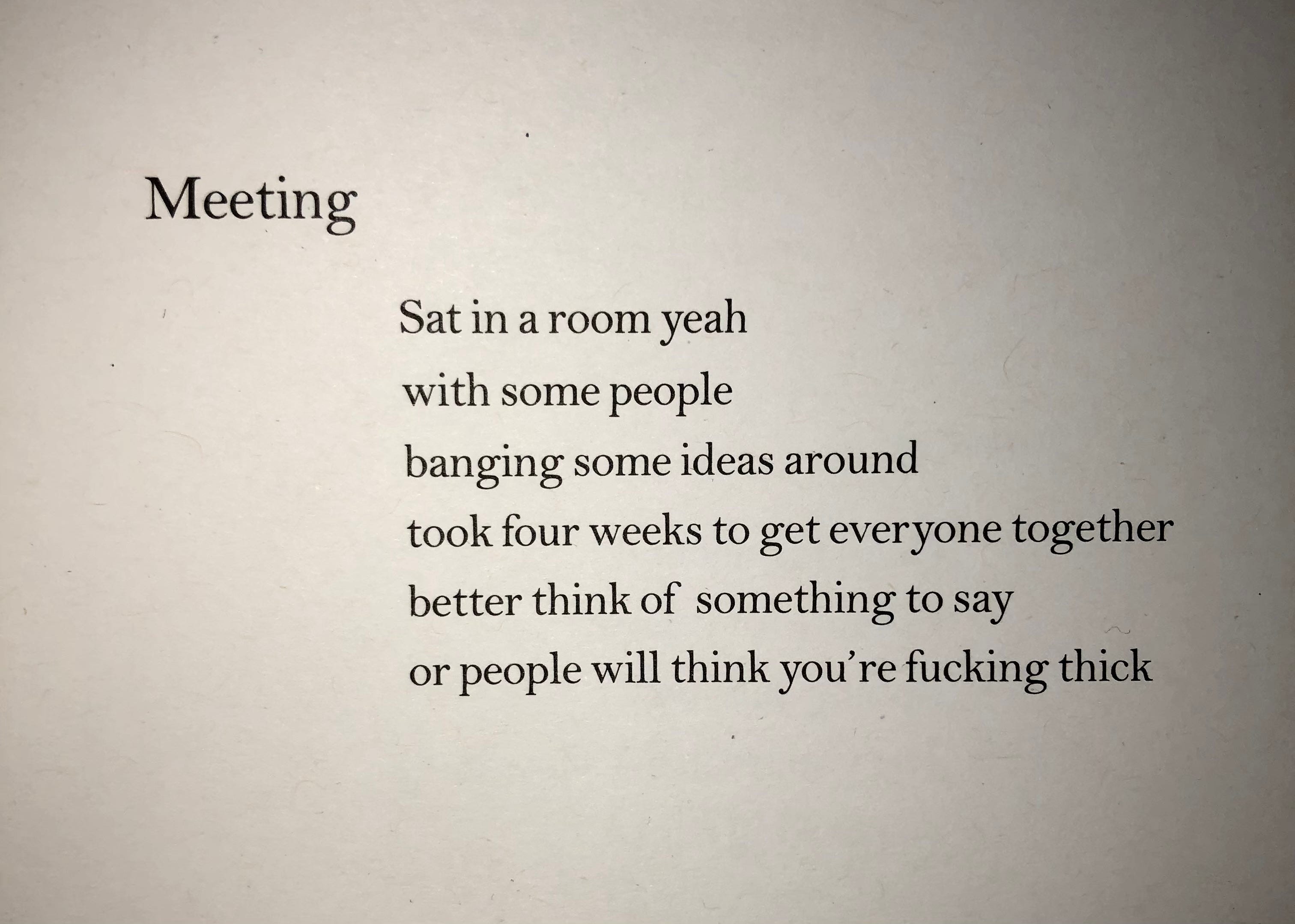
Silence, which might be considered a state of extreme listening, is therefore antithetical to organisations. Silence is considered a void, an absence of something, and if something is not there, it cannot be of value. Can the falling tree in the forest be heard if it’s not speaking? Is Schrodinger’s cat alive if it’s not miaowing?
“It is better to remain silent at the risk of being thought a fool, than to talk and remove all doubt of it.”
— Maurice Switzer
Thus, sound becomes a bias and a default, as we need some indication that something is happening because we can hear it. We are attuned to sound - even in the womb, we are able to hear the rhythm of mother’s heartbeat. The world is full of sound; true silence is increasingly rare and precious.
Yet not all sound is the same, certainly not if you live in a city, town or developed country. Most of it is not sound but noise. It is distraction, it is garbage, it is bullshit. It keeps us from truly hearing, from deepening our understanding and our connection.
If we’re always talking or thinking about what we’re going to say, we cannot possibly be listening. It’s like expecting a river to flow in two directions at once. If we’re never in silence, we can never deepen our reflection, our introspection or the quality of our attention to our own lives.
When we’re communicating only as broadcast, we get to relieve ourselves of whatever we’re carrying without ever considering what others are carrying, without allowing the possibility for genuine connection.
If we’re on the receiving end of the broadcast, the same effect is present - there is no space for real presence or to be with what is being expressed. It’s a weird analogue of social media where we log on, post endlessly and never really engage with what anyone else is trying to say.
Think back to a family argument or a heated disagreement at work. All the parties involved will likely have been speaking at each other nonstop. Imagine if they had slowed down, paused, allowed a moment to consider what they had just heard. Imagine if a silence emerged here.
I often ask busy coaching clients to take one hour in their week to simply sit in silence. No need to meditate or journal or do anything at all, just with no distractions. Most of them find it deeply challenging and uncomfortable.
“When the mind has moments of silence, you still are, but not as a thought. Not as a someone or something to be evaluated or judged.”
— Adyashanti
Silence is full of meaning; it is a rich form of communication, of possibility and potentiality. My good friend Mark McCartney has been running Silent Conversations for some time now, a practice where a group of people from around the world will meet online in various practices of silence. Participants in his groups report incredible feelings of connection, intimacy and meaning found in their collective silence.
Exploring the extremes of silence is revealing. The journalist Michael Finkel’s book ‘The Stranger In The Woods’ is the extraordinary true story of a modern-day hermit, Christopher Knight, a man who lived in the woods of Maine for 27 years until 2013.
The book recounts the profound experiences of peace and meaning that Knight found in his self-imposed solitary life and is interspersed with brief references to research on silence and solitude:
“When one experiences silence, absent even reading, the cerebral cortex typically rests. Meanwhile, deeper and more ancient brain structures seem to be activated - the subcortical zones. People who live busy, noisy lives are rarely granted access to these areas. Silence, it appears, is not the opposite of sound. It is another world altogether, literally offering a deeper level of thought, a journey to the bedrock of the self.”
Life as a hermit is at the edges, yet its prevalence throughout human history, including modern-day meditation retreats, shows that silence is not just the lack of something, but the presence of something invisible to us until we reduce the noise.
The Inuit people, who live through long winters without sunlight, have a word that speaks to the creative potential of silence: ‘qarrtsiluni’. It means sitting together in the darkness, waiting for something to emerge.
Francis Weller has suggested that qarrtsiluni is what we are collectively called to practice as we enter what might be a long darkness for humanity - it is not solitary survival but quiet intimacy and connection that will help us through these times.
“The average group can tolerate no more than fifteen seconds of silence: if we are not making noise, we believe, nothing good is happening and something must be dying.”
— Parker Palmer
Tipping Point: navigating collapse and crisis.
“After a few minutes he lowers his phone, the screen effervescent against his white shirt. “It’s not true,” he says, with finality. “The UN predicted sixty years based on current rates of soil degradation in certain, extreme cases of agro-erosion. Most worst-case scenarios see a thousand-year finishing line. The thirty years stat is fearmongering.” He slips the phone into his pocket, walks over to your brother, smiles.”
In her short essay, ‘Thirty Years’, the artist Annabel Howard evokes a powerful reality of the future of food and our planet.
About me.
I’m a leadership coach, consultant and facilitator living in Berlin.
Contact me to:
Make sense of what’s going on with you, your work and your life through my coaching practice.
Make sense of what’s going on in your organisation through group dialogues, workshops and strategy sessions.
Understand your organisation and its culture as if it were a person, through The Human Organisation framework.
Have a real conversation.
At the heart of my work is helping individuals and organisations to figure out what is really going on.
You can also find out more about my work with men & masculinity here.
[Main image from Stylist Mag]