
Just hope?
I write because I love it and I’d like to do more of it. If you enjoy reading my Substack, please consider supporting my writing with a low-cost subscription. It’s the price of one coffee a month, and sometimes just as refreshing.
Your support means I can spend more time researching and writing this each week, going to more esoteric and interesting places. Thank you.
The way of love is not
a subtle argument.
The door there
is devastation.
Birds make great sky-circles
of their freedom.
How do they learn it?
They fall, and falling,
they’re given wings.
— Rumi
A calm start to the year, then?
I have just finished reading the novel ‘Prophet Song’ by Paul Lynch. It is set in present-day Ireland, one where an authoritarian regime has taken control of the country and is gradually enforcing its brutal will (sound familiar?). Yeah, I know - some people watch the Strictly Come Dancing Christmas special; I read bleak, dystopian fiction.
But the fiction is no stranger than reality. If anything, it is a disturbingly plausible warning; the song of a prophet I suppose.
The main character in the book is a scientist and mother of four called Eilish. Early in the book, her husband, the deputy leader of the teachers’ union, is taken by the newly formed secret police (also sound familiar?) and ‘disappeared’; it seems the regime does not like anyone protecting people’s rights or helping young people to learn (really familiar).
Eilish has no idea what has happened, she is in that horrific limbo of not knowing the fate of someone she cares about, all whilst trying to keep her family alive. Against her wishes, her eldest son soon absconds to join the rebels, leaving Eilish with her elder teenage daughter, teenage son and baby boy.
She soon loses her job as the regime takes over scientific institutions (hmm...). And things get much worse from there. Gradually, everything is stripped from her. Just when she thinks it can’t get any more horrendous, it does.
As I came towards the end of the book, I felt a growing horror as I realised there would be no redemption for Eilish. There was no neat or happy ending, nor a tidy conclusion to wrap things up. There was no sense of why this was happening or what would come next.
Instead, it was the unrelenting sense of a world that had changed irrevocably and a future that was uncertain. If there was any hint of a conclusion or central message, it was an invitation towards acceptance of reality, however painful that might be.
I have never read a book that has left me feeling such a strong sense of sadness, yet I will recommend it to everyone.
We must have hope. Of course, we must. Hope sustains us, it requires us to believe that there is a future worth fighting for.
But we cannot only have hope. We can keep it in our hearts, but we must simultaneously hold an unflinching gaze towards what is, and a willingness to face that reality.
This is the essence of The Stockade Paradox, named after a US prisoner of war in Vietnam, Admiral James Stockdale.
Stockdale spent over 7 years in one of Vietnam’s most brutal prisons. Years later, he was asked about the prisoners who didn’t survive this ordeal:
“Oh, that’s easy, the optimists. Oh, they were the ones who said, “We’re going to be out by Christmas”. And Christmas would come, and Christmas would go. Then they’d say, “We’re going to be out by Easter”. And Easter would come, and Easter would go. And then Thanksgiving, and then it would be Christmas again. And they died of a broken heart. This is a very important lesson. You must never confuse faith that you will prevail in the end—which you can never afford to lose—with the discipline to confront the most brutal facts of your current reality, whatever they might be.”
This is the paradox we are called to hold now. We can emerge into brightness, but we may need to sit in the dark for a while. What we cannot do - must not do - is cultivate a naiveté of how dark it could get. This kind of hope is also a kind of blindness.
To have hope alone is to skip over the present and the near future, to a time when everything has resolved to our satisfaction, by forces unknown. It removes us from the story, and this invites tragedy, for our best approach to what is coming might be to consider how we need to change and adapt rather than waiting for rescue.
This is not a capitulation to darkness, but the seeds of how we create something different out of the ruins. Sooner or later in our personal lives, we experience moments of loss, grief and suffering. We endure, and we continue, but not as the same person we were before. We are changed by the experience.
The way in which we are changed depends on the perspective we are able to gain from our own plight. Is this awful, unbearable moment the end - or is it the start of something else? Is our suffering only pain, or does it contain within it some grace or wisdom? Does our loss, even if deeply painful, also bring some form of liberation?
We can remain wounded, or we can heal with a scar. We can retreat from life, or face into it with more resilience.
It is not a mere act of choice, of course; we each bring our own psyche and flaws to these moments. So the invitation is to prepare ourselves, in the literal sense and as best we can, for the world that is emerging - not the one we simply hope for.
I’ll leave you with this from a character towards the end of Prophet Song, offering her own story to Eilish:
“We were offered visas, you know, to Australia, and we turned them down, my husband said no, plain and simple, he said it was impossible to go at the time and I suppose he was right, and how could he have known anyhow, how could any of us have known what was going to happen, I suppose other people seemed to know, but I never understood how they were so certain, what I mean is, you could never have imagined it, not in a million years, all that was to happen, and I could never understand those that left, how they could just leave like that, leave everything behind, all that life, all that living, it was absolutely impossible for us to do so at the time and the more I look at it the more it seems there was nothing we could do anyhow, what I mean is, there was never any real room for action, that time with the visas, how were we supposed to go when we had so many commitments, so many responsibilities, and when things got worse there was just no room for manoeuvre, I think what I’m trying to say is that I used to believe in free will, if you had asked me before all this I would have told you I was free as a bird, but now I’m not so sure, now, I don’t see how free will is possible when you are caught up within such a monstrosity, one thing leads to another thing until the damn thing has its own momentum and there is nothing you can do, I can see now that what I thought of as freedom was really just struggle and that there was no freedom all along.”
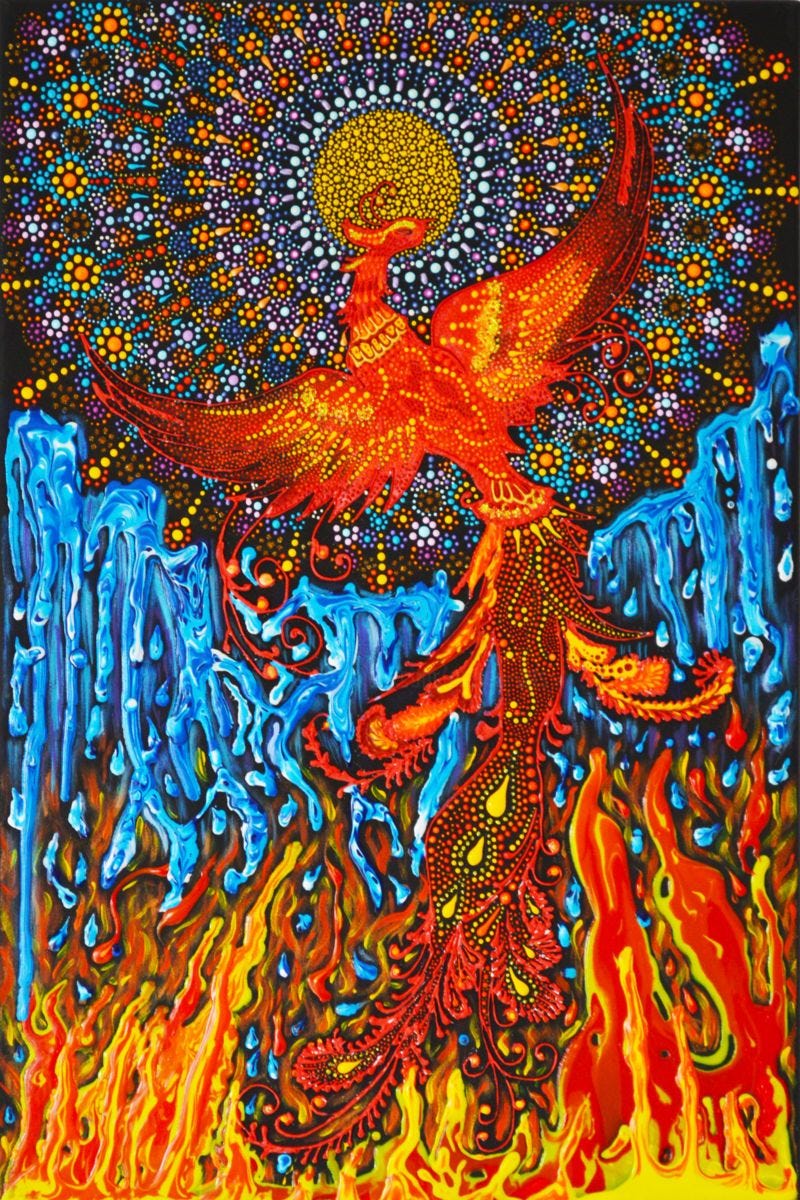
“The phoenix must fall and must allow the fall into the flames and into the ashes in order to find in those unseen depths the archetypal energies of renewal and revivification that gives it wings again. If we resist the falling into dissolution that is required by the archetype, we lose our wings.”
— Michael Meade
About me.
I’m a leadership coach, consultant and facilitator living in Berlin.
Contact me to:
Make sense of what’s going on with you, your work and your life through my coaching practice.
Make sense of what’s going on in your organisation through group work, workshops and strategy sessions.
Have a real conversation.
At the heart of my work is helping individuals and organisations to figure out what is really going on.
You can also find out more about my work with men & masculinity here.